

Airbnb
Airbnb Account Creation
& Onboarding
Airbnb's acquisition of HotelTonight brought hotels onto a platform built for individual hosts. Getting a single hotel live took seven steps, three people and a Google Form. I redesigned it as one onboarding system: account managers set each hotel up in Hubble, an existing Airbnb tool, and hotels finished their own signup in a guided flow.
Airbnb
Airbnb Account Creation
& Onboarding
Airbnb's acquisition of HotelTonight brought hotels onto a platform built for individual hosts. Getting a single hotel live took seven steps, three people and a Google Form. I redesigned it as one onboarding system: account managers set each hotel up in Hubble, an existing Airbnb tool, and hotels finished their own signup in a guided flow.
Scroll to move through the story
- Role
- Timeline
- Audience
- Areas of influence
- Highlights
The problem
Airbnb acquired HotelTonight in 2019 and, with it, a new kind of partner: hotels. Airbnb's onboarding was built for individual hosts renting out a room or a home. Hotels are run by revenue managers who sell dozens of room types across fifteen to twenty booking channels at once. They needed to list those room types, supply state and local tax details, and be treated like the businesses they were.
Every hotel that went live on Airbnb passed through an account manager, a contractor and a Google Form. That worked for a handful of properties. It couldn't scale as more hotels signed on.
People needed to get a single hotel room live: an account manager, a contractor and the hotel
3
The inherited flow
Every hotel went through the same sequence before a single room could be booked. Seven steps and three people: no way in without an account manager, and no way to finish without a contractor.

Step 1: Establish contract
The account manager reached out to the hotel's revenue manager and established a contract. This was the only way in. Hotels had no path to start on their own.

Step 2: Create account
The revenue manager created an Airbnb account through a flow built for individual hosts. It had no way to list room types, capture state and local requirements, or speak to hotels as the businesses they were.

Step 3: Collect data
The account manager collected room types, amenities and other listing details through a Google Form. Hotels often didn't know where to find their tax ID or what some of the required numbers meant.

Step 4: Create listings
A contractor built the hotel's listings by hand in the contractor's own personal Airbnb account.

Step 5: Transfer listings
The contractor transferred the finished listings to the revenue manager's account. The new flow removed this step entirely.

Step 6: Review listings
The revenue manager reviewed every listing, checked for errors, edited prices and published.

Step 7: Ready to publish
Inventory was live and bookable on Airbnb.
Hubble
No invite until the setup is done
HotelTonight's account managers tracked every hotel in a Google spreadsheet. We moved them onto Hubble, an existing Airbnb tool, and I designed one system across both sides: set the hotel up first, then send the invite.
The rate travels with the invite
Manual forms meant wrong rates and missed updates. Now every hotel arrives with its terms attached, and Airbnb has a record of each acceptance.
One flow, two kinds of hotel
Managed hotels arrive with their details filled in while smaller hotels filled them in manually. This path was held back at launch, but the flow was built for it.
The new journey, showing where the account manager's setup in Hubble hands off to the hotel's onboarding.
Welcome
A continuation, not an introduction
Once setup was done, Hubble sent the hotel its invite. In testing, early versions of that email read like a cold introduction to hotels that already had a relationship with HotelTonight. The final email and landing page picked up where that relationship left off and told hotels what the next few steps would ask of them.
An invite nobody had to type
Hubble couldn't send email, so the ops team would have written every invite by hand as plain text. Connecting Hubble to Airbnb's email system meant each hotel got a branded invite automatically the moment its setup was finished.
The invite email and landing page: what hotels saw first, and what they'd be asked for next.
Account creation
The form already knew them
Hotels started by creating a business account and confirming their business details. Everything the account manager had entered in Hubble arrived already filled in, so hotels checked their information instead of typing it again. A progress bar showed from the first screen that the flow was short.
Support we couldn't ship
Testing showed that a built-in support option put hotels at ease, but real-time support wasn't possible in this release. Instead, each step linked to a Hotels FAQ written for exactly what that step asked of them.
Business account and business details, pre-filled from the account manager's setup in Hubble.
Room types
What we stopped asking
Hotels listed the room types they wanted to sell on the platform, and the flow created a field for each one. Tax details came out of the hotel's signup entirely, and photos, pricing and calendars moved to the property dashboard, where hotels could return to after their account was live.
The wrong person had the answers
In testing, the person creating the account often wasn't the one who knew the property's tax details. Asking for them during signup stopped the whole flow. Taking them out let hotels finish and bring in the right colleague later.
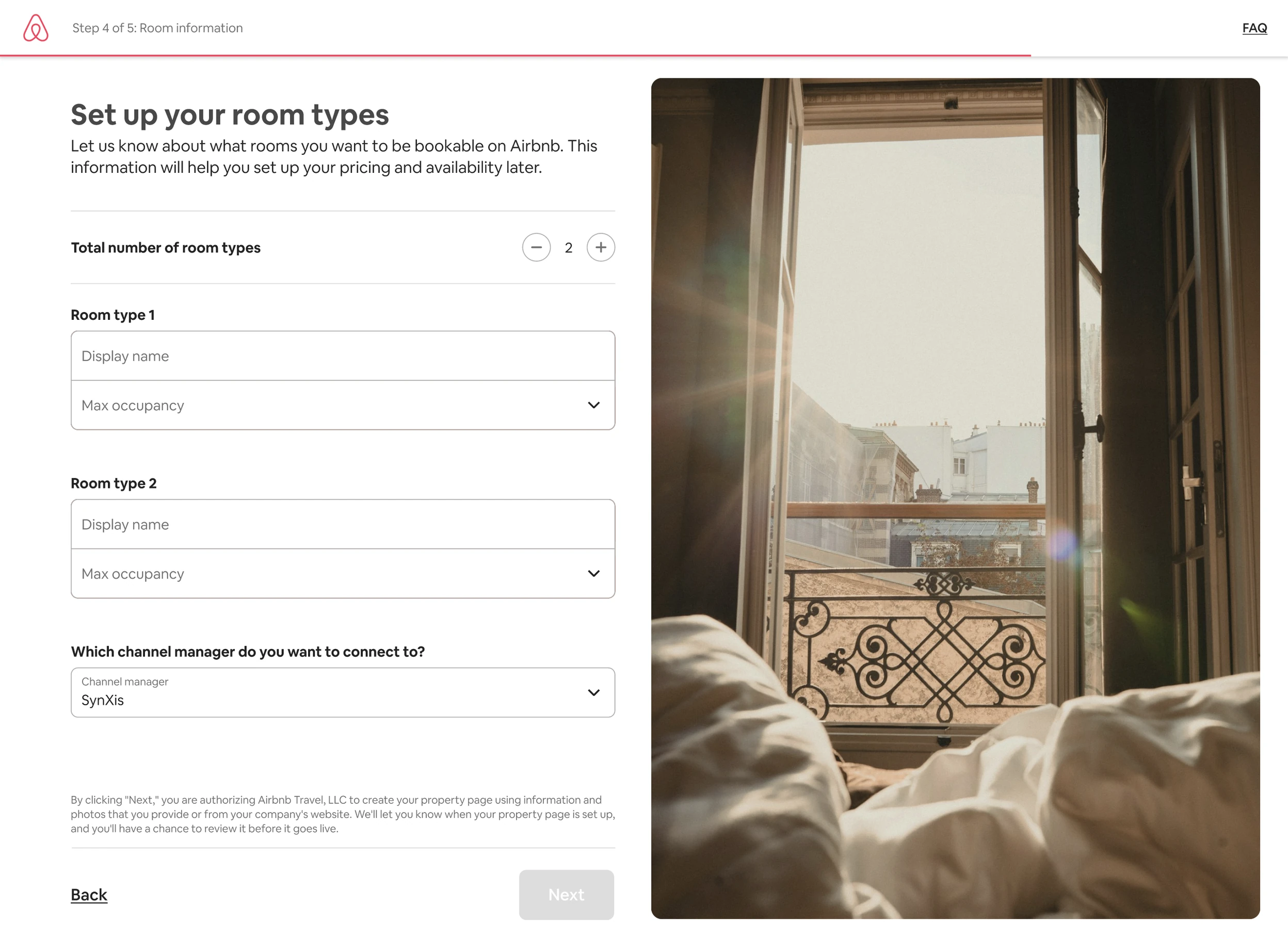
Room type setup: hotels name their room types, and the flow builds a field for each.
Agreements
Declining isn't a dead end
The last steps were agreements: Airbnb's Community Commitment, which every host signs, and the hotel's partnership terms, including the commission rate set in Hubble. Signing led straight to the property dashboard, where the rest of setup was waiting.
A decline with a warning
If a hotel declined the terms, a modal explained what declining meant before anything changed, then returned them to the start of the flow.
Community Commitment, partnership terms, and the confirmation that hands hotels to their property dashboard.
Learnings
The first version of the account creation and onboarding flow launched in Q1 2020. Hotels could now set up their account through a structured, brand-consistent flow, with fields pre-filled from Hubble, a progress bar signaling scope, and complex property setup moved to a dashboard they could return to after signup.
Airbnb laid off 25% of its staff in May 2020, and the Hotels vertical was among the first casualties. The new flow had been live for weeks, not months, so there is no post-launch data on what it changed.
What it did establish: professional hospitality businesses could onboard onto Airbnb without a contractor building their listings for them. Hotels completed their own signup, and the path for smaller hotels to start without an account manager was already built. For a platform that had never built for that audience, that was the proof of concept.
The end