

Headspace
Headspace Admin Portal
Research & Proposal
Headspace's B2B Admin Portal hadn't been redesigned since 2017, and the merger with Ginger exposed how poorly it served the companies using it. Twelve interviews and the first direct survey of Admins led to one recommendation: split the portal in two, one for Admins and one for Headspace's own teams.
Headspace
Headspace Admin Portal
Research & Proposal
Headspace's B2B Admin Portal hadn't been redesigned since 2017, and the merger with Ginger exposed how poorly it served the companies using it. Twelve interviews and the first direct survey of Admins led to one recommendation: split the portal in two, one for Admins and one for Headspace's own teams.
Scroll to move through the story
- Role
- Timeline
- Audience
- Areas of influence
- Highlights
The problem
By 2022, the Admin Portal served 2,000+ partner companies on a structure built in 2017. Features had been added for years, but nobody had asked Admins directly what they needed.
The portal also served two audiences at once. Admins used it to manage their company's benefit, while Headspace's own teams used it to troubleshoot eligibility files and investigate member issues. The merger with Ginger, which brought its own internal platform, made the overlap impossible to ignore.
User types, internal and external, sharing one portal
5
"The engagement reports are pretty underwhelming. It doesn't give us much detail and I am not super fond of it being a PDF. I wish it was an actual dashboard where we could filter the information and slice and dice it."
— Admin survey respondent, 2022
The Admin Portal as Admins used it in 2022, largely unchanged since 2017.
Research
No map? Build it
Before the first interview, I mapped the portal end to end, from setting up a company to resolving a member issue. Twelve interviews with seventeen people across Headspace, Ginger and partner companies then tested what the map suggested.
One need, five teams
Data integration made the top three for four of the five groups. The toolkit and company hierarchy each made it for two.
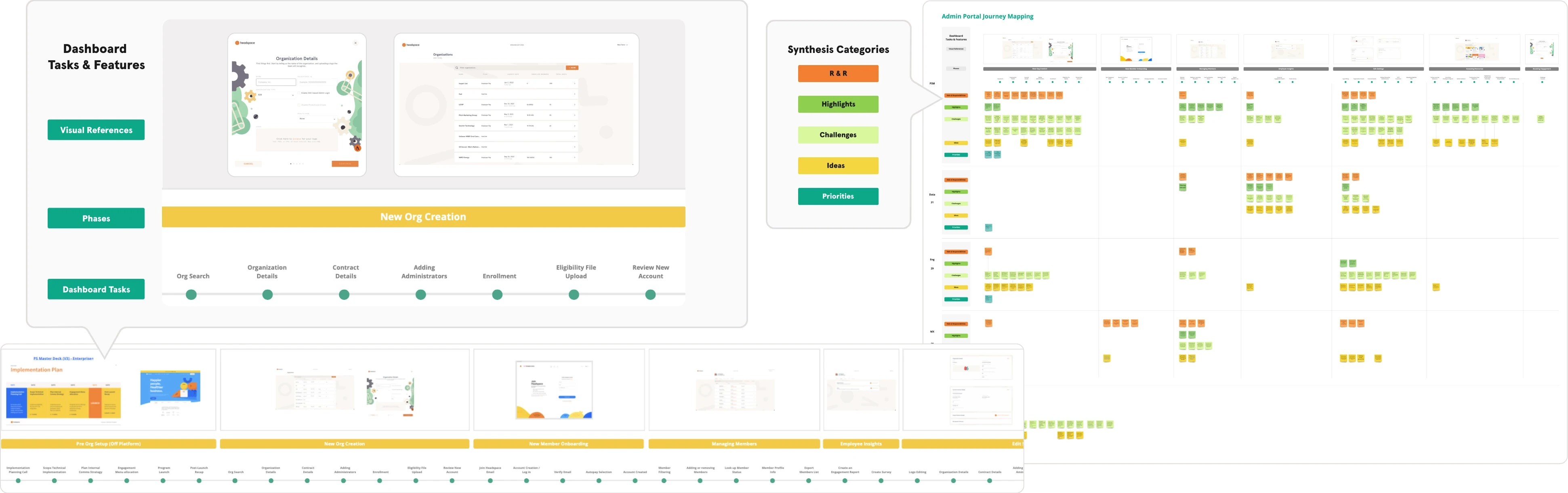
The Admin Portal journey across five user types, from company setup to member support.
The admin survey
Size matters
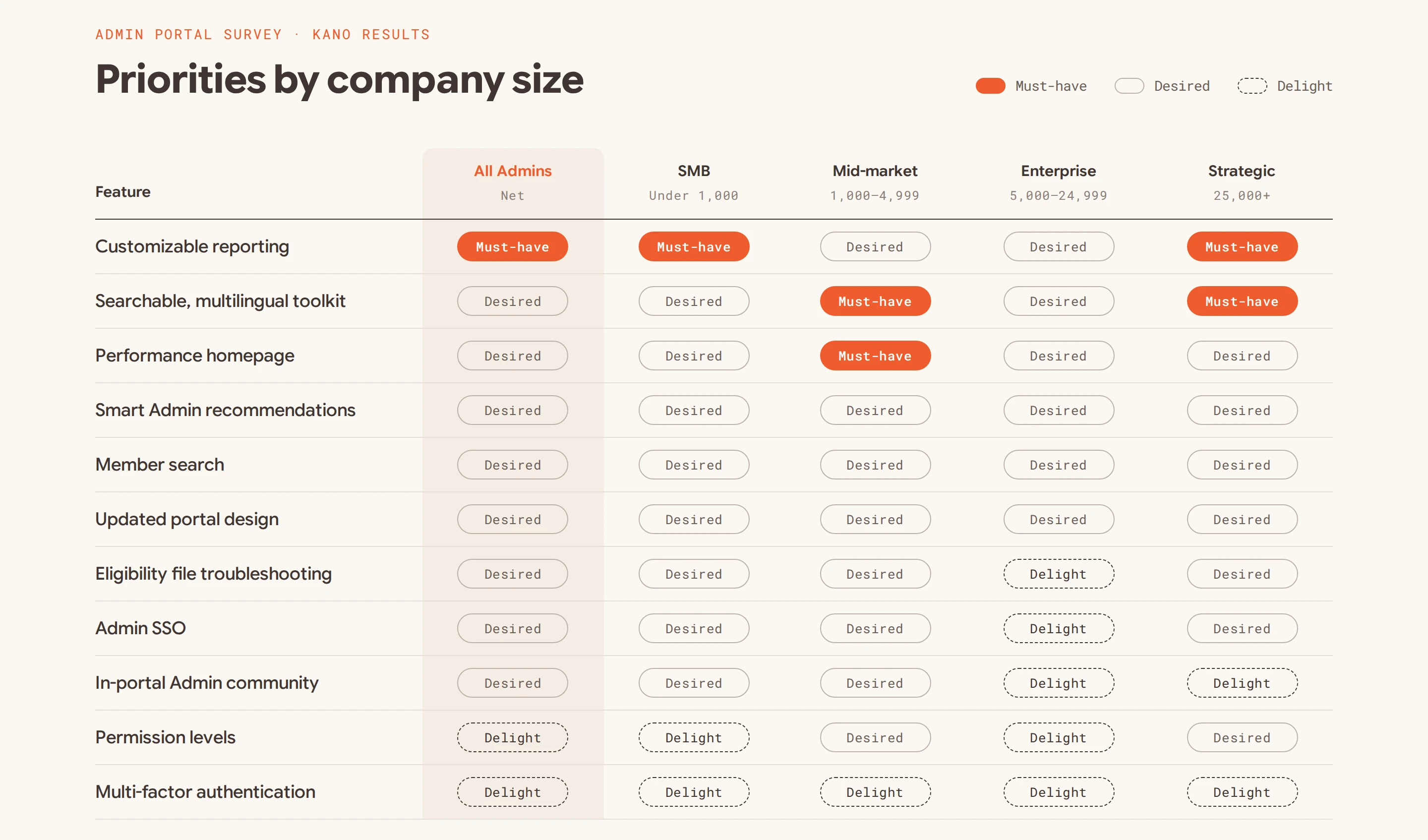
Headspace had never surveyed its Admins directly. I partnered with a UX researcher to design the first survey, split by company size so each segment's priorities stayed visible instead of being averaged away.
Only one must-have
Customizable reporting was the only must-have overall, but only the smallest and largest companies called it essential. Admins at companies with 1,000 to 4,999 employees ranked a searchable toolkit and a performance homepage first.
Admins surveyed through the PSM team
700
Direct responses received
147
Response rate, no incentive
21%
Company-size segments, from SMB to Strategic
4
Synthesis
Research 1, Designer 0
Every idea was scored for need and impact, then checked against feature requests, support tickets and competitors. The in-portal Admin community I was most excited about landed in the low-priority corner. The data was right.
Pain versus payoff
Need measured how often a problem came up, how many people it affected and how much it hurt. Impact measured revenue, enrollment, Admin satisfaction and internal efficiency.
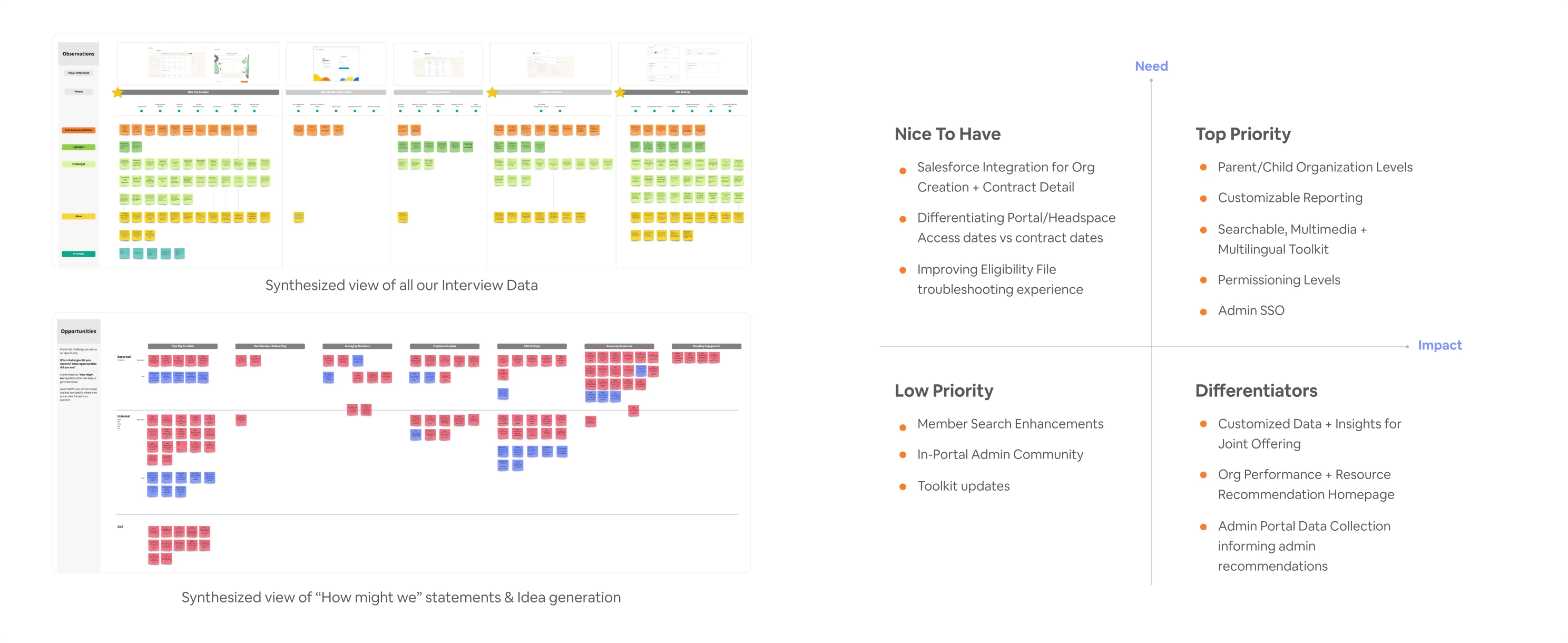
Every opportunity plotted by need and impact, with the Admin community in the low-priority corner.
The proposal
Two audiences, neither served
Comparing Ginger's internal platform with the Admin Portal showed internal tools crowding out what Admins came for. I proposed an Admin Portal built only for Admins, with internal work moving to tools built for Headspace's own teams.
The features Admins never found
Up to 44% of Admins didn't know the settings features existed, and 65% had never heard of SFTP uploads. Those were the screens internal teams lived in.
A list that couldn't carry over
For Ginger, showing employers who had enrolled would reveal who was seeking mental health care. The Headspace portal's most-used feature was a legal problem for the combined offering.
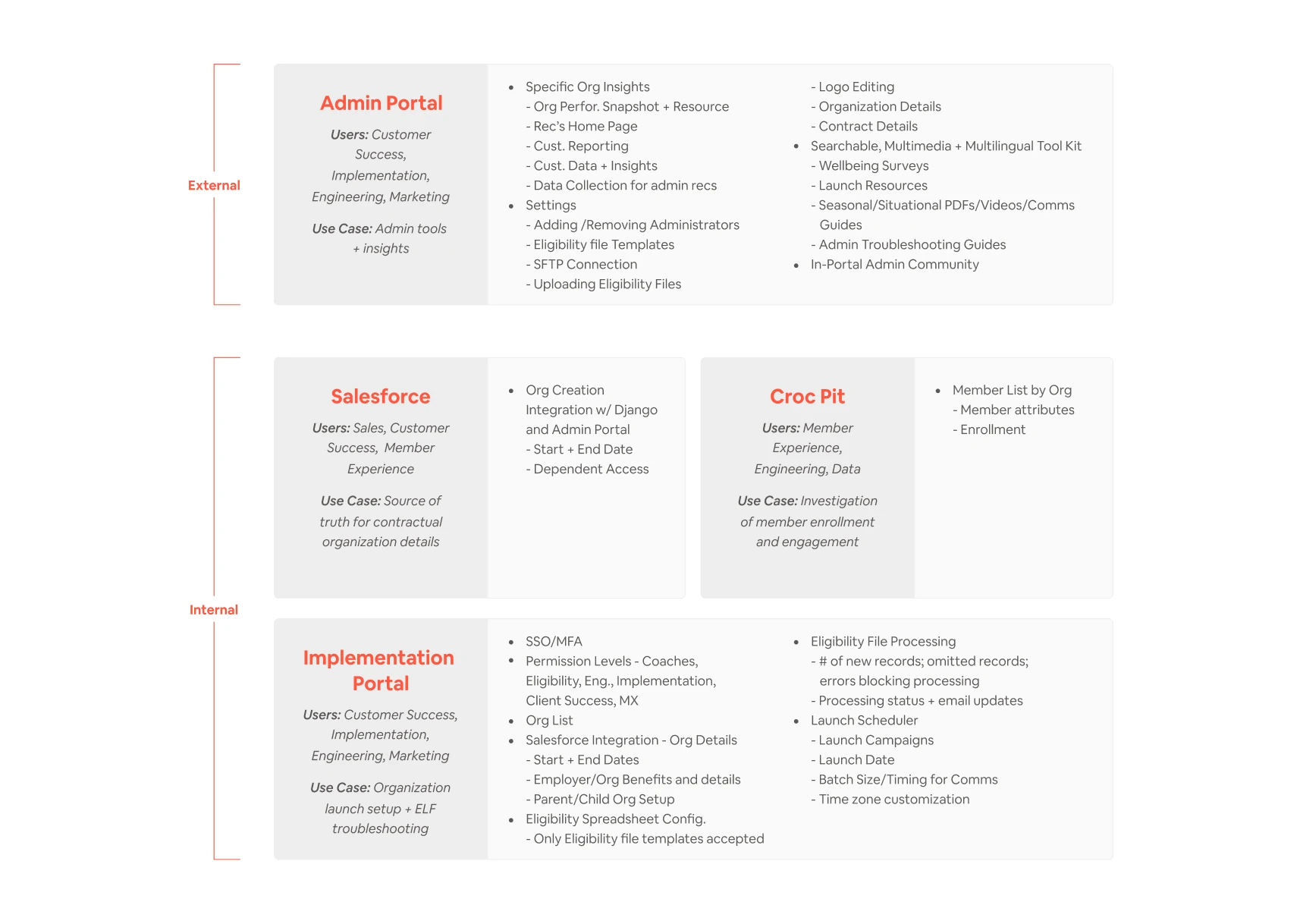
The proposed split: what moves to internal tools, and what the Admin Portal keeps.
Wireframe explorations
Built to convince, not to ship
Research is easy to dismiss as a slide deck. I wireframed what an Admin-only portal could be, starting with what Admins asked for most: reporting they could explore instead of a PDF.
A feature that had lost clients
Headspace had lost clients for not offering Challenges, but the old version was too buggy and manual to offer beyond top-tier accounts. The Features tab put launching one in every Admin's hands.
Open the proposed Home tab to see live enrollment, engagement and content reports, then move through Members, Settings, Features, Resources and Reports.
Learnings
Before this project, Headspace had never gone directly to its Admin population for research. Every insight about what Admins needed had been filtered through PSM conversations: secondhand, incomplete, and shaped by what internal teams thought Admins wanted rather than what they actually said.
Seventeen stakeholders across twelve interviews, a survey of 700 Admins, four additional validation sources, an in-person working session, and a Need × Impact framework that overruled instinct, including my own, produced a proposal that reframed the entire problem. This wasn't a portal that needed a redesign. It was a portal that had been asked to serve two completely different audiences for years, and had failed both of them as a result.
The proposal went to leadership in Q3 2022 and was approved. Foundational Phase 0 work began rolling out before the year was out. That outcome matters, but what I'm most proud of is that the research program itself changed how the team thought about Admins. Not as a user type to design for, but as a constituency that had never been properly heard.
The end